Open Dynamic Robot Actuator
Actuator componentBrushless belt-reduced research actuator core with a v1.1 prepared encoder-kit route, precision printing requirements and separately integrated motor control. [9] [10] [7]
Build & first use →Official website
- For
- Builders able to fabricate precision mechanical parts and integrate motor control [1]
- Cost
- No current cost or bill of materials established yet.
- Source rights
- Named licenses are documented by part. Review licenses
- Unknowns
- host computer, tools, operating system not fully established. Review gaps
Source researched · Not tested by us
Sources checked · Research details

Licenses & related hardware
- License
- BSD-3-Clause · Details by part
Overview
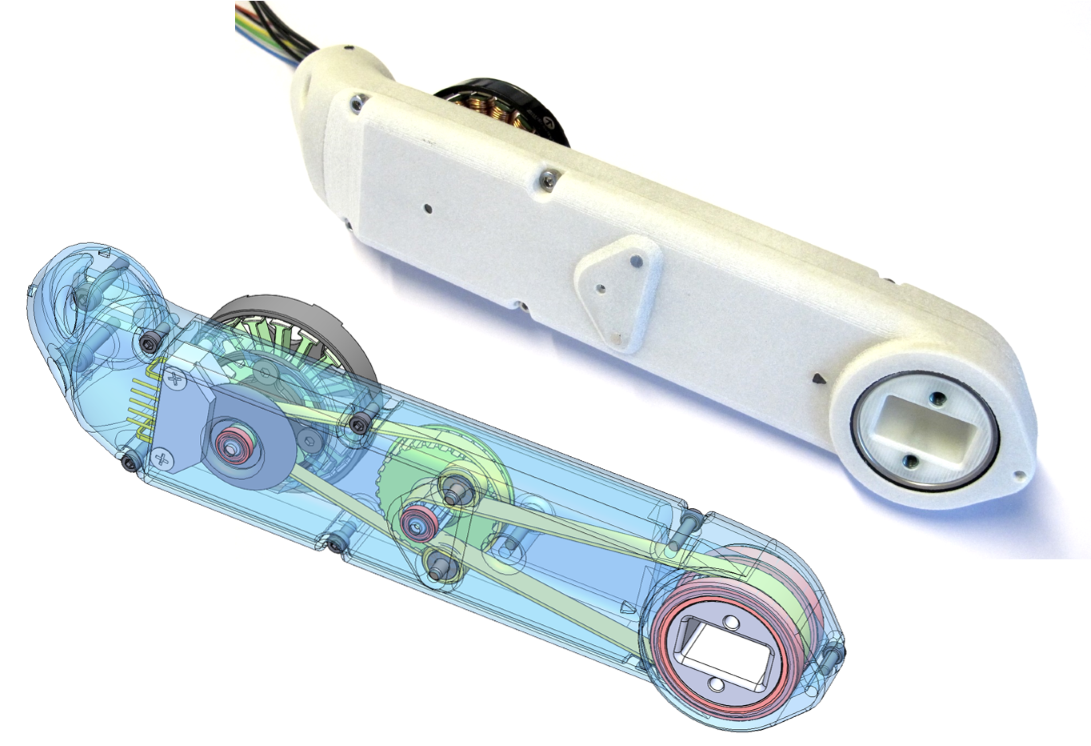
The ODRI brushless actuator uses an outrunner motor, optical encoder and two timing-belt stages with a combined 9:1 reduction. This profile selects the v1.1 core documented in the preserved hardware repository. Its surrounding shell depends on the robot using it, so a core parts list is not a complete robot or ready-to-command actuator package. [9]
Is this for you?
3D preview
ODRI actuator module as placed in the biped left hip (scoped subsystem). Scoped subsystem: one actuator module exactly as placed in the project biped_6dof_v1 STEP assembly at commit 66af152, the left hip flexion-extension subassembly (_hip_fe_left_side_bl_biped) with its source placements and named sub-hierarchy: motor module (Antigravity 4004 stator, rotor and custom shaft), encoder and code wheel, two-stage timing-belt transmission with center and output pulleys and belt tensioners, bearings, fasteners, and the biped-specific hip shell structure. The rest of the biped (body, the other three actuator modules, legs and feet) is not shown; the download is the complete biped STEP. The project states that its robots use the same core components and differ only in the surrounding shell. The file does not state whether this core is the v1 or the v1.1 revision described in this profile. Purchased component models (motor stator and rotor, bearings, encoder, code wheel and fasteners) are kept as placed; their third-party terms are unknown. Licensed BSD-3-Clause. Fit and function are not verified.
BSD-3-Clause: the repository LICENSE is the BSD 3-Clause License, “Copyright (c) 2019, New York University and Max Planck Gesellschaft.” Purchased component models inside this subassembly (Antigravity 4004 motor stator and rotor, SBN bearings, Avago AEDT-9810 encoder, 5000 cpr code wheel and ISO fasteners) are kept as placed; their third-party terms are unknown. License: BSD-3-Clause · upstream notice.
The 3D preview loads after the page.
Drag to orbit · Scroll or pinch to zoom · Right-drag to pan. Use the view buttons for front, side and top views. The tree shows names supplied by the source; unnamed bodies remain labeled as such.
Download original biped_6dof_v1 STEP for the complete biped (gzip; the preview shows one actuator subassembly) · File checksums and provenance
Separate bodies can be inspected in the model tree. Explode is a viewing aid, not an assembly sequence.
Model sources
The preview uses the linked original design. Source grouping is retained where present; the caption identifies whether this is an assembly or one component.
Source, license and scale
Source: Open Dynamic Robot Initiative (New York University and Max Planck Gesellschaft), revision 66af1522b4fba0ec4a1d7790e66f5e4652208d30. Original and preview: BSD-3-Clause. Preview conversion by Open Source Robotics; original file unchanged. Preview coordinates are centered and rounded to six decimal places. STEP preview triangulated in millimetres. No physical part tested.
Viewer: three-cad-viewer 5.0.7 (MIT license). Confirm scale and manufacturing settings before printing.
What you need
Hardware & parts
Assembly & first use
Cost
No current, complete configuration-specific build cost has been established for this profile.
Project notes
The v1.1 change is a prepared encoder assembly
The guide describes a PWB ODRI encoder kit containing the prepared motor-shaft assembly, aluminum center pulley and Broadcom AEDT-9810-Z00 encoder head. Upstream states that the prepared shaft and the self-made earlier version are functionally interchangeable. The v1.1 route reduces machining and shaft preparation; it does not remove the need for a motor, belts, bearings, printed parts, shells or control electronics. Current availability of that historical supplier kit was not verified. [9]
The selected BOM names a T-Motor Antigravity 4004 300kV, a first-stage belt 150 mm long and 4 mm wide, and a second-stage belt 201 mm long and 6 mm wide. Alternative tensioner bearings and roller diameters are described separately. A builder must keep the selected tensioner arrangement consistent rather than combining every listed alternative into one assembly. [9]
Printing and fit are functional requirements
The documentation separates structural FDM/SLS parts from precision SLA, polyjet or multijet pulleys. Bearing-seat dimensions and the specified positive-Z print orientation affect fit; the guide warns that oversized bearing seats can make a part unusable. These requirements are more specific than simply having printable STL files. No parts were printed or dimensionally inspected in this review. [9] [10]
The guide reports a 160 mm segment, approximately 150 g assembled-module weight and 2.5 Nm output at 12 A. Those figures belong to its documented module example, not every surrounding shell or duty cycle. In particular, the supplied description does not establish a continuous thermal torque rating, and no catalog test reproduced the figures. [9]
Select and validate the control route separately
The repository documents TI evaluation-board electronics using the F28069M LaunchPad and DRV8305 booster boards, with robots operated at 24 V. It describes a real-time PC/CAN control route and separate firmware flashing. The electronics are additional to the mechanical core; this profile does not assign their board limits to the motor or claim a verified complete electrical configuration. [7] [8] [9]
The flashing guide distinguishes RAM/debug execution from a flash build and corresponding boot settings. It leaves toolchain installation and source checkout unfinished, and notes that ending the debugger does not stop the running board program. The linked actuator-testing page has no substantive test procedure. Complete firmware selection, commissioning and performance validation therefore remain work beyond the preserved mechanical design. [8] [11]
The hardware repository is BSD-3-Clause licensed. External purchased components, control firmware and host software need their own source and license assessment. The complete delivered budget remains unknown, including precision fabrication, tooling, electronics and sourcing. No machining, assembly, flashing, torque measurement or hardware motion was performed here. [3] [7] [9] [10]
What we checked
Source research only; no installation, physical build or performance test performed. No affiliate links added.
Not yet established
- Requirements: operating system, host computer, tools
- A step-by-step setup summary
Updates
- Upstream last updated
- Sep 6, 2022 [2]
- Latest release
- Not established
- Profile updated
- Oct 25, 2026
- Sources last checked
- Oct 1, 2026
- Next review
- Oct 31, 2026
- Reviewed revision
- 66af1522b4fba0ec4a1d7790e66f5e4652208d30 (commit snapshot; no published stable release found) · combined hardware and software repository
Source files and licenses
Available project sources support research coverage; complete build and commercial qualification remain separate.
| Layer | Availability / license |
|---|---|
| mechanical design | available · BSD-3-Clause Actuator core design files and linked robot-specific shell structures. No geometry or physical build verification claimed. [3] [5] [6] [9] [12] |
| electronics | not found · License not fully assessed Selected route documents purchased TI evaluation boards and control/toolchain requirements. Complete matched electronics fabrication, firmware and host-software payloads were not established in this hardware-repository review; not a claim of closed source. [6] [7] [8] |
| firmware | not found · License not fully assessed Selected route documents purchased TI evaluation boards and control/toolchain requirements. Complete matched electronics fabrication, firmware and host-software payloads were not established in this hardware-repository review; not a claim of closed source. [6] [7] [8] |
| software | not found · License not fully assessed Selected route documents purchased TI evaluation boards and control/toolchain requirements. Complete matched electronics fabrication, firmware and host-software payloads were not established in this hardware-repository review; not a claim of closed source. [6] [7] [8] |
| documentation | available · BSD-3-Clause Selected repository documentation; external component documentation retains separate terms. [3] [5] [7] |
Selected torque-controlled hardware configuration does not require a particular learned policy or dataset.
References
Each source links to the exact revision we read. “Used for” shows where this page relies on it.
Project sources
- S001 open-dynamic-robot-initiative/open_robot_actuator_hardware: README.md
Revision, date & where cited
github.com · revision
66af152· Accessed Oct 1, 2026
Used for: Assembly & first use - S002 open-dynamic-robot-initiative/open_robot_actuator_hardware: commit 66af152
- S003 open-dynamic-robot-initiative/open_robot_actuator_hardware: LICENSE
Revision, date & where cited
github.com · revision
66af152· Accessed Oct 1, 2026
Used for: Select and validate the control route separately, Source files and licenses - S004 open-dynamic-robot-initiative/open_robot_actuator_hardware: files
Revision, date & where cited
github.com · revision
66af152· archive file inventory · Accessed Oct 1, 2026 - S005 mechanics/tri_finger_edu_v1/README.md
Revision, date & where cited
github.com · revision
66af152· Accessed Oct 1, 2026
Used for: Source files and licenses - S006 mechanics/finger_edu_v1/README.md
Revision, date & where cited
github.com · revision
66af152· Accessed Oct 1, 2026
Used for: Source files and licenses - S007 electronics/ti_electronics/README.md
Revision, date & where cited
github.com · revision
66af152· Accessed Oct 1, 2026
Used for: What you need, Select and validate the control route separately, Source files and licenses - S008 electronics/details/details_flashing.md
Revision, date & where cited
github.com · revision
66af152· Accessed Oct 1, 2026
Used for: Is this for you?, What you need, Select and validate the control route separately, Source files and licenses - S009 mechanics/actuator_module_v1/actuator_module_v1.1.md
Revision, date & where cited
github.com · revision
66af152· Accessed Oct 1, 2026
Used for: Overview, Is this for you?, What you need, Hardware & parts and 4 more - S010 mechanics/actuator_module_v1/details/details_3d_printed_parts.md
Revision, date & where cited
github.com · revision
66af152· Accessed Oct 1, 2026
Used for: What you need, Printing and fit are functional requirements, Select and validate the control route separately - S011 mechanics/actuator_module_v1/details/details_actuator_module_testing.md
Revision, date & where cited
github.com · revision
66af152· Accessed Oct 1, 2026
Used for: Is this for you?, Select and validate the control route separately - S012 Complete archive filenames
Revision, date & where cited
github.com · revision
66af152· Preserved archive inventory · Accessed Oct 1, 2026
Used for: Source files and licenses - S016 Upstream image and reuse attribution
Media-only review: Upstream image of the Open Dynamic Robot Initiative actuator module; this component is not a complete robot. Reuse basis: BSD-3-Clause; inspected LICENSE and the pinned file inventory for nearer notices. Original image unchanged; displayed responsively. This does not refresh technical or cost evidence.Revision, date & where cited
Open Dynamic Robot Initiative, New York University and Max Planck Gesellschaft · github.com · revision
66af152· Image SHA-256 862793d17209aa641fc14d256905d6bcf9522057df47235a4a7f9aaad3c0db46; repository · Accessed Oct 25, 2026
Videos
- S013 Open Dynamic Robot Initiative (YouTube channel)
The project’s own YouTube channel, linked from the project’s own documentation. Not reviewed by us for accuracy.Revision, date & where cited
YouTube channel Open Dynamic Robot Initiative · youtube.com · Accessed Oct 4, 2026
- S014 20180914 Optical Foot Contact Switch Demonstration (YouTube video)
Video from the project’s own channel (Open Dynamic Robot Initiative), linked from the project’s own documentation. Not reviewed by us for accuracy.Revision, date & where cited
YouTube video Open Dynamic Robot Initiative · youtube.com · Accessed Oct 4, 2026
- S015 20190524 Circle Art (YouTube video)
Video from the project’s own channel (Open Dynamic Robot Initiative), linked from the project’s own documentation. Not reviewed by us for accuracy.Revision, date & where cited
YouTube video Open Dynamic Robot Initiative · youtube.com · Accessed Oct 4, 2026
Correction guidance · Discussion is not enabled · Profile format 0.6.0-draft.1
Change history
2026-10-04 — Added 3 YouTube reference(s) (S013, S014, S015): official channel or videos linked from the pinned upstream sources. Existing claims, source-check dates and evidence are unchanged.
2026-10-25 — Added an attributed upstream image with linked reuse terms; technical evidence dates unchanged.