OpenDrone electronics
Motor controllerOpenESC-20x20 is a four-channel brushless motor controller with available KiCad sources and unresolved differences between headline ratings and technical test notes. [1] [5]
Build & first use →Official website
- For
- Electronics developers evaluating a specific ESC design and its qualification gaps [1]
- Cost
- No current cost or bill of materials established yet.
- Source rights
- Some licenses are unresolved. Review licenses
- Unknowns
- tools, operating system not fully established. Review gaps
Source researched · Not tested by us
Sources checked · Research details

Licenses & related hardware
- License
- CERN-OHL-S-2.0 · license not fully assessed for software, documentation · Details by part
Overview
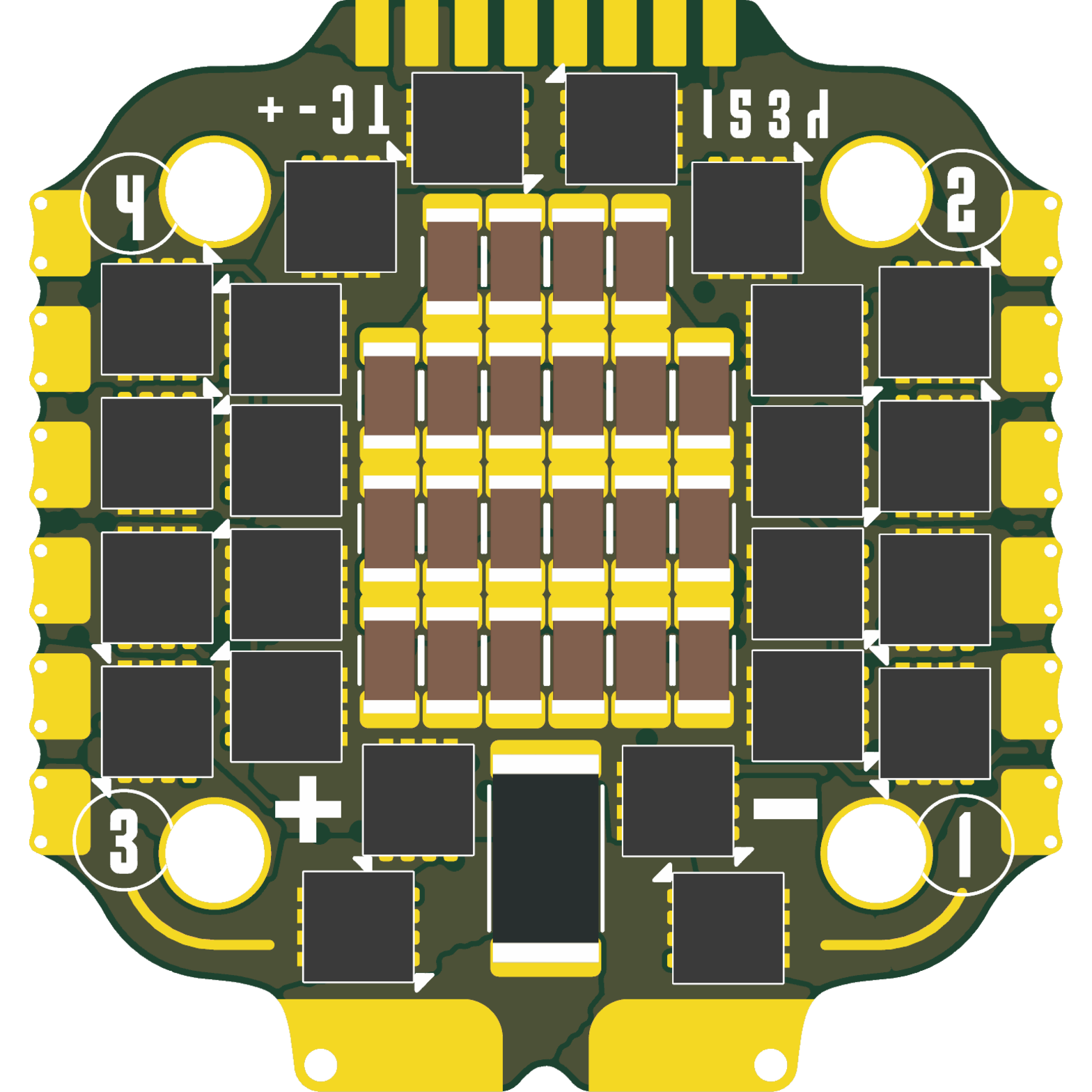
This entry covers one OpenDrone board: OpenESC-20x20, a four-in-one brushless motor controller with a 20 × 20 mm mounting pattern. It is not a complete drone or a review of every OpenDrone electronics product. Each channel has its own MCU, gate driver and six MOSFETs; control uses DShot through an eight-pin connector. [1] [5]
The reviewed source is pinned to commit 859abd9d1e104675a488604f8d1a8c46ac0c3c86. Its revision table identifies rev3.3 dated August 25, 2026. The thermal tests and firmware audit described below are dated August 21, before the documented rev3.2 and rev3.3 changes; the thermal account does not explicitly identify the tested board revision. [2] [5]
3D preview
OpenESC-20x20 rev3.2 board assembly. The source-defined OpenESC-20x20 KiCad board at title-block revision 3.2, including its 182 placed component models. It does not represent the later rev3.3 board, an assembled drone or verified electrical and thermal performance.
The 3D preview loads after the page.
Drag to orbit · Scroll or pinch to zoom · Right-drag to pan. Use the view buttons for front, side and top views. The tree shows names supplied by the source; unnamed bodies remain labeled as such.
Download original KiCad source bundle (ZIP) · File checksums and provenance
Separate bodies can be inspected in the model tree. Explode is a viewing aid, not an assembly sequence.
Model sources
The preview uses the linked original design. Source grouping is retained where present; the caption identifies whether this is an assembly or one component.
Source, license and scale
Source: OpenDrone contributors and KiCad library contributors, revision 859abd9d1e104675a488604f8d1a8c46ac0c3c86. Original and preview: CERN-OHL-S-2.0; KiCad models CC-BY-SA-4.0 with exception. Preview conversion by Open Source Robotics; source files unchanged inside the downloadable bundle. Preview coordinates are centered and rounded to six decimal places. KiCad evaluated the source board and placed 3D models, then the generated STEP was triangulated in millimetres. No physical part tested.
Viewer: three-cad-viewer 5.0.7 (MIT license). Confirm scale and manufacturing settings before printing.
What you need
Hardware & parts
Assembly & first use
Cost
No current, complete configuration-specific build cost has been established for this profile.
Project notes
The headline current rating is not a verified operating limit
The README lists 40 A continuous per channel. The detailed technical notes describe a different picture from tests on one board: a demonstrated die-temperature plateau at 26 A, a partly extrapolated 30–34 A fan-cooled range, and destructive solder reflow around 40 A sustained. These conditions do not substantiate an unconditional 40 A continuous rating. The underlying external test logs were not independently inspected here, and this publication performed no electrical or thermal tests. [1] [5]
The same notes describe a short burst on one channel and a separate board-level burst. Those must not be combined into a sustained four-motor rating. Cooling, motor load, firmware settings and the exact board revision remain prerequisites for interpreting any of these figures. [5]
Match power and current sensing to the actual board
The documented input is 2–6S LiPo, 6.0–25.2 V; this is not the separate 8S product. There is no BEC and the technical notes state that input protection is not fitted. A supplied 470 µF bulk capacitor is described as an external part to solder across the battery terminals, rather than an already-installed PCB component. A complete build still needs a matched flight controller, motors, power system and wiring. No current delivered cost was verified. [1] [5]
Current sensing measures the shared board supply, not each motor independently. The notes describe a serious switching-related measurement error through revision 3.1 and a filter-network change in revision 3.2. They explicitly say that the proposed improvement had not yet been verified on hardware in that write-up. The later revision table alone does not prove that validation occurred. [5]
Flash verification does not qualify the motor configuration
The technical notes report an audited firmware configuration with thermal foldback disabled and a motor-Kv default that needs product-specific adjustment. The preserved flashing script points to an AM32 F421 PB4 version-17 bootloader and an AM32_OPENESC_20_F421_2.20 binary, using external AM32 and unlocker checkouts. Its paths and feedback commands are macOS-specific, and the ST-LINK pogo fixture is in another repository. [5] [6]
The script erases, writes and verifies firmware, but contains no explicit motor-Kv or temperature-limit configuration step. The binary defaults were not inspected, so successful flashing cannot be presented here as proof that the documented configuration gaps are resolved. No flashing script or upstream executable was run. [6]
Available design files and remaining qualification
The archive contains the KiCad project, schematics, PCB layout, local symbols, footprints and component geometry. The technical notes identify KiCad 10 and a six-layer board. File presence is established; schematic parity, board rules, fabrication outputs and assembled-board performance were not validated. The notes also identify PCB-only bulk components, which makes unqualified regeneration from the schematic an unsuitable assumption. [5] [7]
The repository declares CERN-OHL-S-2.0 for hardware and includes its license text. That does not substitute for reviewing the separately obtained AM32 firmware, unlocker tools or fixture sources. This profile records a useful available electronics design alongside unresolved rating, revision-validation and configuration evidence, rather than treating source availability as flight qualification. [1] [3] [5] [6]
What we checked
Source research only; no installation, physical build or performance test performed. No affiliate links added.
Not yet established
- A limitations summary
- Requirements: operating system, tools
- A step-by-step setup summary
Updates
Source files and licenses
Available project sources support research coverage; complete build and commercial qualification remain separate.
| Layer | Availability / license |
|---|---|
| mechanical design | available · CERN-OHL-S-2.0 PCB layout and component geometry only, not an airframe or complete drone mechanical design. [3] [5] [7] |
| electronics | available · CERN-OHL-S-2.0 Repository declares CERN-OHL-S-2.0; source files inspected by inventory, not electrical design validation. [1] [3] [5] [7] |
| firmware | not found · License not fully assessed AM32 is linked externally; required bootloader and firmware binary are not established as contained in this board archive. Exact upstream source/build/license matching remains unreviewed. [5] [6] [7] |
| software | available · License not fully assessed Production script available; root license declaration is explicitly hardware-scoped, so script-specific licensing and external tool licenses are not assigned here. [6] |
| documentation | available · License not fully assessed Overview and detailed technical notes available; rating and revision limitations retained. [1] [5] |
Motor-control electronics scope uses no learned model or training dataset.
References
Each source links to the exact revision we read. “Used for” shows where this page relies on it.
Project sources
- S001 OpenDrone-hw/OpenESC-20x20: README.md
Revision, date & where cited
github.com · revision
859abd9· Accessed Oct 1, 2026
Used for: Overview, What you need, Hardware & parts, Assembly & first use and 4 more - S002 OpenDrone-hw/OpenESC-20x20: commit 859abd9
- S003 OpenDrone-hw/OpenESC-20x20: LICENSE
Revision, date & where cited
github.com · revision
859abd9· Accessed Oct 1, 2026
Used for: Available design files and remaining qualification, Source files and licenses - S004 OpenDrone-hw/OpenESC-20x20: files
Revision, date & where cited
github.com · revision
859abd9· archive file inventory · Accessed Oct 1, 2026 - S005 Technical design notes
Revision, date & where cited
github.com · revision
859abd9· Pinned source text; upstream agent instructions treated solely as source material, never executed · Accessed Oct 1, 2026
Used for: Overview, What you need, Hardware & parts, Assembly & first use and 5 more - S006 flash_openesc20.sh
Revision, date & where cited
github.com · revision
859abd9· Pinned source text; upstream agent instructions treated solely as source material, never executed · Accessed Oct 1, 2026
Used for: What you need, Assembly & first use, Flash verification does not qualify the motor configuration, Available design files and remaining qualification and 1 more - S007 inventory.json
Revision, date & where cited
github.com · revision
859abd9· Pinned source text; upstream agent instructions treated solely as source material, never executed · Accessed Oct 1, 2026
Used for: Available design files and remaining qualification, Source files and licenses - S010 Upstream image and reuse attribution
Media-only review: Upstream board-layout illustration of the OpenESC 20×20 motor controller, not a photograph of a manufactured board. Reuse basis: CERN-OHL-S-2.0; inspected LICENSE and the pinned file inventory for nearer notices. Original image unchanged; displayed responsively. This does not refresh technical or cost evidence.Revision, date & where cited
OpenDrone-hw contributors · github.com · revision
859abd9· Image SHA-256 3db903faf2b29521b8e2de52f0f430a338f486b6edd84521d6493423dfe18946; repository · Accessed Oct 25, 2026
Videos
- S008 How Drone ESCs Work (so I built my own) (YouTube video)
Video from the project’s own channel (OpenDrone), linked from the project’s own documentation. Not reviewed by us for accuracy.Revision, date & where cited
YouTube video OpenDrone · youtube.com · Accessed Oct 4, 2026
- S009 OpenDrone (YouTube channel)
The project’s own YouTube channel, found by searching YouTube and checked against the channel page. Not reviewed by us for accuracy.Revision, date & where cited
YouTube channel OpenDrone · youtube.com · Accessed Oct 4, 2026
Correction guidance · Discussion is not enabled · Profile format 0.6.0-draft.1
Change history
2026-10-04 — Added 2 YouTube reference(s) (S008, S009): official channel or videos linked from the pinned upstream sources. Existing claims, source-check dates and evidence are unchanged.
2026-10-25 — Added an attributed upstream image with linked reuse terms; technical evidence dates unchanged.