Stanford Pupper
Robot / hardware buildThe original servo-driven Stanford Pupper, a Raspberry Pi quadruped whose upstream support has ended in favor of a separate v3 design. [1] [5] [6] [7] [8] [9]
Build & first use →Official websiteUpstream build guide
- For
- Legged robotics learners; Builders maintaining original Pupper hardware [1]
- Cost
- No current cost or bill of materials established yet.
- Source rights
- Some licenses are unresolved. Review licenses
- Unknowns
- operating system not fully established. Review gaps
Source researched · Not tested by us
Sources checked · Research details
Licenses & related hardware
- License
- MIT · license not fully assessed for mechanical design, electronics, documentation · Details by part
Overview
This profile covers the original Pupper associated with StanfordQuadruped and its legacy build guide. The repository now carries an end-of-life notice and points to the separate Pupper v3 effort. Its v3 brushless motors, Raspberry Pi 5 and learned locomotion claims must not be applied to the original servo-driven build. [1]
Is this for you?
What you need
Hardware & parts
Assembly & first use
Open the upstream getting-started guide [1] [5] [6] [7] [8] [9] · Project documentation [1] [5] [6] [7] [8] [9]
Cost
No current, complete configuration-specific build cost has been established for this profile.
3D preview
Preview not available yet. Design-source links are available, but the reviewed record does not establish unambiguous reuse rights for a hosted CAD preview.
Model sources
Design-source links are available, but the reviewed record does not establish unambiguous reuse rights for a hosted CAD preview.
Project notes
What the original build requires
The captured BOM specifies 12 JX CLS6336 servos and a Raspberry Pi 4. Printed mounts are only part of the structure: the robot also uses routed carbon-fiber plates and links, bearings, heat-set inserts and a custom power-distribution board. The PCB tab identifies a particular Gerber branch and specifies 2 oz copper. The fabrication choices and supplier-specific servo-horn assembly note need to stay with the selected parts. [5] [9]
The workbook includes separate hardware, electronics, tools and fabrication tabs, as well as an explicitly unreleased Hardware V2 tab. Its historical headline total is $892.58, excluding tools, tax and shipping; the tools tab separately totals $157.07 and includes a charger and soldering iron. Individual and bulk purchasing estimates are separate. These figures are upstream spreadsheet estimates, with no current region-specific stock, shipping or tax check; mixing the unreleased tab or a newer kit into the original list would change the configuration. [9]
Installation precedes geometric calibration
The original guide starts with a Raspberry Pi 4 and a named 2019 Raspbian Buster Lite image, then adds separate setup files and the StanfordQuadruped controller. PS4 pairing, networking and service startup are part of the documented workflow. A current operating-system substitution has not been tested here. [6]
Calibration then aligns each of the 12 servo-driven joints with known horizontal or vertical references while the legs are supported off the ground. The guide specifically uses joint centers as the alignment reference and says unreachable positions can indicate incorrectly fitted servo arms. This is additional work after mechanical assembly, not something a source archive verifies. [7]
For this original design, the operation guide specifies 2S LiPo power and warns against exceeding 8.4 V. The source-researched profile records that configuration constraint without claiming an electrical or gait test. The controller repository has an MIT license; external CAD, board and component rights still need separate reconciliation. With upstream support ended, a support offer would also require our own verified installation and repair procedure. [1] [3] [8]
What we checked
Source research only; no installation, physical build or performance test performed. No affiliate links added.
Not yet established
- Requirements: operating system
- A step-by-step setup summary
Updates
- Upstream last updated
- Jul 3, 2024 [2]
- Latest release
- Not established
- Profile updated
- Oct 26, 2026
- Sources last checked
- Sep 30, 2026
- Next review
- Oct 30, 2026
- Reviewed revision
- dc0c5e2089cf2c0aac3c59982a4f140c31803175 (commit snapshot; no published stable release found) · combined hardware and software repository
Source files and licenses
Available project sources support research coverage; complete build and commercial qualification remain separate.
| Layer | Availability / license |
|---|---|
| mechanical design | available · License not fully assessed Linked CAD/STL and fabrication routes described; full external CAD set and asset licenses not preserved/reconciled. [5] [9] |
| electronics | available · License not fully assessed BOM explicitly identifies xt60cable Gerbers and KiCad repository; exact board license and full purchased-component scope unresolved. [9] |
| firmware | not found · License not fully assessed Complete purchased servo firmware not established. [4] [9] |
| software | available · MIT Controller repository only; external setup and joystick dependencies have separate sources. [3] |
| documentation | available · License not fully assessed Legacy documentation snapshots preserved. [5] [6] [7] [8] |
Original PWM-controller route, not the separate v3 learned locomotion platform.
References
Each source links to the exact revision we read. “Used for” shows where this page relies on it.
Project sources
- S001 stanfordroboticsclub/StanfordQuadruped: README.md
Revision, date & where cited
github.com · revision
dc0c5e2· Accessed Sep 30, 2026
Used for: Overview, Is this for you?, What you need, Hardware & parts and 2 more - S002 stanfordroboticsclub/StanfordQuadruped: commit dc0c5e2
- S003 stanfordroboticsclub/StanfordQuadruped: LICENSE
Revision, date & where cited
github.com · revision
dc0c5e2· Accessed Sep 30, 2026
Used for: Installation precedes geometric calibration, Source files and licenses - S004 stanfordroboticsclub/StanfordQuadruped: files
Revision, date & where cited
github.com · revision
dc0c5e2· archive file inventory · Accessed Sep 30, 2026
Used for: Source files and licenses - S005 Original Pupper assembly
Revision, date & where cited
stanfordroboticsclub / project contributors · pupper.readthedocs.io · Read the Docs revision 9c556d02 · Accessed Sep 30, 2026
Used for: Is this for you?, What you need, Hardware & parts, Assembly & first use and 2 more - S006 Original Pupper software_installation
Revision, date & where cited
stanfordroboticsclub / project contributors · pupper.readthedocs.io · Read the Docs revision 9c556d02 · Accessed Sep 30, 2026
Used for: Is this for you?, What you need, Hardware & parts, Assembly & first use and 2 more - S007 Original Pupper calibration
Revision, date & where cited
stanfordroboticsclub / project contributors · pupper.readthedocs.io · Read the Docs revision 9c556d02 · Accessed Sep 30, 2026
Used for: Is this for you?, What you need, Hardware & parts, Assembly & first use and 2 more - S008 Original Pupper operation
Revision, date & where cited
stanfordroboticsclub / project contributors · pupper.readthedocs.io · Read the Docs revision 9c556d02 · Accessed Sep 30, 2026
Used for: Is this for you?, What you need, Hardware & parts, Assembly & first use and 2 more - S009 Pupper BOM workbook
Revision, date & where cited
stanfordroboticsclub / project contributors · docs.google.com · Overview, Electronics, PCB, 3D Printed Parts and Carbon Fiber Routed Parts tabs; row numbers included · Accessed Sep 30, 2026
Used for: Is this for you?, What you need, Hardware & parts, Assembly & first use and 2 more - S011 Upstream image and reuse attribution
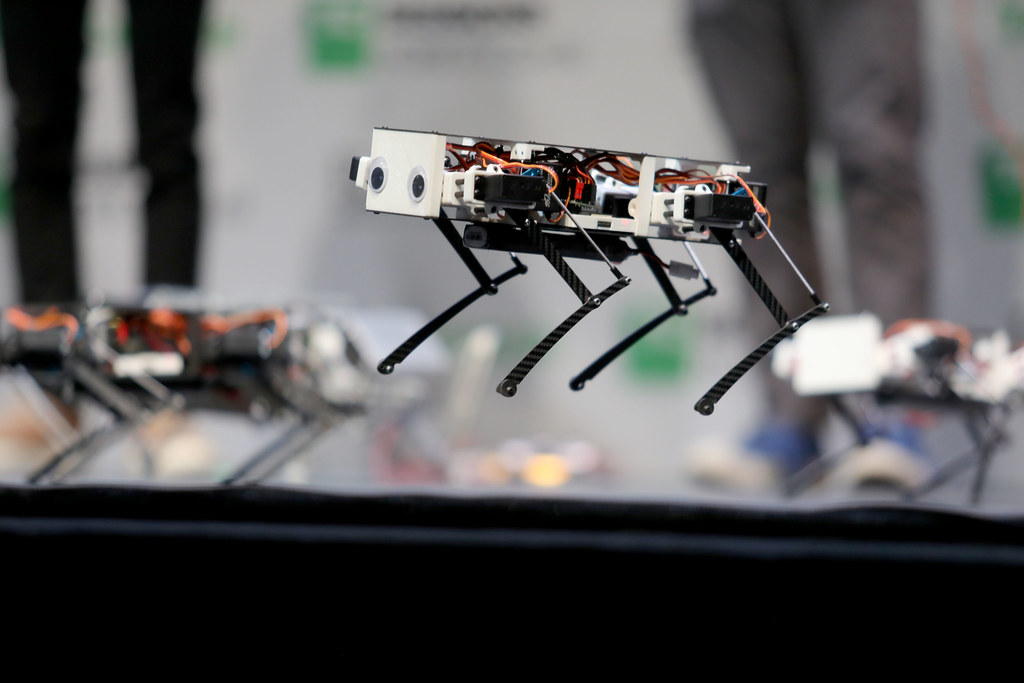
Media-only review: Photograph of the original servo-based Stanford Pupper at TC Sessions: Robotics + AI, March 3, 2020. Reuse basis: CC-BY-2.0. The actual TechCrunch Flickr page credits Max Morse and explicitly licenses this photograph CC BY 2.0 in both its visible license link and structured image metadata. The project’s own StanfordQuadruped README embeds this same Flickr image ID with alt text Pupper CC Max Morse under the original Pupper overview, separately from its newer v3 announcement. Visible hobby servos and original carbon-fiber legs match v1, not brushless v2/v3 or Doggo/Woofer. No action performance claim adopted. Original image unchanged; displayed responsively. Technical/cost evidence dates unchanged.Revision, date & where cited
Max Morse for TechCrunch · flickr.com · Flickr photo 49614690753, creator caption/date/license; StanfordQuadruped README overview Pupper CC Max Morse; image SHA-256 73b769189b3ea7a122a529c5e7ec36e2905128fabe42f399a2a1710293959e60 · Accessed Oct 26, 2026
Videos
- S010 Stanford Pupper (YouTube video)
Video uploaded by Nathan, linked from the project’s own documentation. Not reviewed by us for accuracy.Revision, date & where cited
YouTube video Nathan · youtube.com · Accessed Oct 4, 2026
Correction guidance · Discussion is not enabled · Profile format 0.5.0-draft.1
Change history
2026-10-04 — Added 1 YouTube reference(s) (S010): official channel or videos linked from the pinned upstream sources. Existing claims, source-check dates and evidence are unchanged.
2026-10-26 — Added attributed upstream media with linked reuse terms; technical evidence dates unchanged.