ToddlerBot
Robot / hardware buildA humanoid research platform with distinct 2XC and 2XM motor configurations, separate PCB sourcing and noncommercial hardware terms. [1]
Build & first use →Official websiteUpstream build guideBill of materials
- For
- Robotics research laboratories; Experienced Python and learning-based control developers [1]
- Source rights
- Some licenses are unresolved. Includes noncommercial terms. Review licenses
- Unknowns
- host computer, tools not fully established. Review gaps
Source researched · Not tested by us
Sources checked · Research details

Licenses & related hardware
- License
- CC-BY-NC-SA-4.0 (noncommercial), MIT · license not fully assessed for model weights · Details by part
Overview
ToddlerBot's 2.0 documentation distinguishes toddlerbot_2xc from toddlerbot_2xm. The former is the upstream default; the latter upgrades hip and arm motors. This choice belongs at the beginning of a build plan because it changes the parts and robot configuration. The preserved source is a commit snapshot containing the 2.0 changelog and later locomotion work, not a published stable GitHub release or a frozen hardware bundle. [1] [2] [5] [6]
Is this for you?
3D preview
ToddlerBot 2XC MuJoCo robot model. ToddlerBot in its 2XC configuration (toddlerbot_2xc, the default robot of the project policy runner), from the project MuJoCo model toddlerbot_2xc.xml at commit e337f3b: 45 bodies on the source body tree with the 44 hinge joints at zero and the floating torso at its source height, shown as 45 link meshes. Original and preview both have 1,352,016 triangles; no decimation. The 2XM, gripper and teleoperation-leader variants are not shown. Each link mesh is one fused export that includes modeled vendor servo housings (DYNAMIXEL motors in this configuration); they cannot be separated and their third-party terms are unknown. Collision boxes are not shown. The design is licensed CC BY-NC-SA 4.0 (noncommercial, share-alike) and the codebase MIT; no commercial-use or manufacturing clearance is claimed. Fit and motion are not verified.
Noncommercial license: the ToddlerBot README releases “The ToddlerBot design (Onshape document, STL files, etc.)” under CC BY-NC-SA, linking version 4.0, “which allows you to use and build upon our work non-commercially”; the codebase is MIT-licensed (“Copyright (c) 2023 Haochen Shi”). This preview of the STL link meshes applies CC BY-NC-SA 4.0 with attribution to Haochen Shi and the ToddlerBot contributors, shared alike. The link meshes include modeled vendor servo housings whose third-party terms are unknown. No commercial-use or manufacturing clearance is claimed. License: CC BY-NC-SA 4.0 (ToddlerBot design, README) · upstream notice.
The 3D preview loads after the page.
Drag to orbit · Scroll or pinch to zoom · Right-drag to pan. Use the view buttons for front, side and top views. The tree shows names supplied by the source; unnamed bodies remain labeled as such.
Download original MJCF source bundle (ZIP) · File checksums and provenance
Separate bodies can be inspected in the model tree. Explode is a viewing aid, not an assembly sequence.
Model sources
The preview uses the linked original design. Source grouping is retained where present; the caption identifies whether this is an assembly or one component.
Source, license and scale
Source: Haochen Shi and the ToddlerBot contributors, revision e337f3b177b4b53abff70b31d1695a7b66cc6d2e. Original and preview: CC-BY-NC-SA-4.0 (design: Onshape document, STL files); codebase MIT. Preview conversion by Open Source Robotics; source files unchanged inside the downloadable bundle. Preview coordinates are centered and rounded to six decimal places. Source visual shapes and body transforms evaluated at the reference pose by MuJoCo, then metres converted to millimetres. No physical part tested.
Viewer: three-cad-viewer 5.0.7 (MIT license). Confirm scale and manufacturing settings before printing.
What you need
Hardware & parts
Upstream bill of materials [1] [5] [6] [7] [8] [9] [10]
Assembly & first use
Open the upstream getting-started guide [1] [5] [6] [7] [8] [9] [10] · Project documentation [1] [5] [6] [7] [8] [9] [10]
Cost
No current, complete configuration-specific build cost has been established for this profile.
Project notes
The robot BOM is only one part of procurement
The hardware guide links the robot BOM but explicitly excludes PCB files from that list. Its separate eight-channel board guide supplies a manufacturing ZIP, assembly BOM and component-placement file. It also warns that parts substitutions and final prices can differ. A current complete delivered budget therefore needs the selected motor variant, printed parts and board order reconciled together; no such quotation is established here. [6] [7]
The 1.0-to-2.0 migration is a mechanical and electrical update as well as a software change. It calls for a new communication board and reprinting the parts other than the torso and head. For printing, the guide directs readers to MakerWorld profiles and Onshape CAD; these external design snapshots are not yet a complete locally preserved manufacturing set. The assembly page contains both a work-in-progress notice and a link to a 2.0 interactive manual, so the old embedded PDF should not be assumed to cover every updated part. [5] [8] [9]
Separate software setup from reproducing a learned behavior
The setup guide creates a Python 3.10 environment and chooses platform-specific installation extras. That is only the software foundation. The multi-skill locomotion workflow additionally describes reference motions, per-skill training, depth-data collection, a classifier and separately linked policy checkpoints. Installing the package alone does not reproduce that behavior. [1] [10]
The README assigns MIT terms to code and documentation, and CC BY-NC-SA 4.0 to the robot design. Keep those scopes separate when considering a commercial build or parts offer. The maintainers also state that GitHub Issues is their monitored support route and ask builders to consult the assembly resources first. That describes their process, not a measured response time or our support capability. No assembly, policy run or hardware test was performed here. [1]
What we checked
Source research only; no installation, physical build or performance test performed. No affiliate links added.
Not yet established
- Requirements: host computer, tools
- A step-by-step setup summary
Updates
- Upstream last updated
- Apr 19, 2026 [2]
- Latest release
- Not established
- Profile updated
- Oct 25, 2026
- Sources last checked
- Sep 30, 2026
- Next review
- Oct 30, 2026
- Reviewed revision
- e337f3b177b4b53abff70b31d1695a7b66cc6d2e (commit snapshot; no published stable release found) · combined hardware and software repository
Source files and licenses
Available project sources support research coverage; complete build and commercial qualification remain separate.
| Layer | Availability / license |
|---|---|
| mechanical design | available · CC-BY-NC-SA-4.0 README design license; external editable CAD/3MF snapshot not fully preserved. [1] [8] |
| electronics | available · CC-BY-NC-SA-4.0 Board manufacturing ZIP, BOM and placement file are documented and present; editable project completeness and substitutions unverified. [1] [7] |
| firmware | not found · License not fully assessed Complete firmware sources for purchased actuators and compute not established in this archive review. [4] |
| software | available · MIT Code license; design files have separate noncommercial terms. [1] [3] [4] |
| model weights | available · License not fully assessed Upstream checkpoint link; payloads, exact configuration and individual licenses not verified or preserved here. [1] |
| datasets | not found · License not fully assessed README describes collecting skill data; no complete matched dataset preserved for the reviewed workflow. [1] |
| documentation | available · MIT README explicitly includes documentation in codebase license. [1] [3] [4] |
References
Each source links to the exact revision we read. “Used for” shows where this page relies on it.
Project sources
- S001 hshi74/toddlerbot: README.md
Revision, date & where cited
github.com · revision
e337f3b· Accessed Sep 30, 2026
Used for: Overview, Is this for you?, What you need, Hardware & parts and 3 more - S002 hshi74/toddlerbot: commit e337f3b
- S003 hshi74/toddlerbot: LICENSE
Revision, date & where cited
github.com · revision
e337f3b· Accessed Sep 30, 2026
Used for: Source files and licenses - S004 hshi74/toddlerbot: files
Revision, date & where cited
github.com · revision
e337f3b· archive file inventory · Accessed Sep 30, 2026
Used for: Source files and licenses - S005 CHANGELOG.md
Revision, date & where cited
github.com · revision
e337f3b· Accessed Sep 30, 2026
Used for: Overview, Is this for you?, What you need, Hardware & parts and 2 more - S006 docs/hardware/01_bill_of_materials.rst
Revision, date & where cited
github.com · revision
e337f3b· Accessed Sep 30, 2026
Used for: Overview, Is this for you?, What you need, Hardware & parts and 2 more - S007 docs/hardware/02_pcb8ch.rst
Revision, date & where cited
github.com · revision
e337f3b· Accessed Sep 30, 2026
Used for: Is this for you?, What you need, Hardware & parts, Assembly & first use and 2 more - S008 docs/hardware/03_3d_printing.rst
Revision, date & where cited
github.com · revision
e337f3b· Accessed Sep 30, 2026
Used for: Is this for you?, What you need, Hardware & parts, Assembly & first use and 2 more - S009 docs/hardware/04_assembly_manual.rst
Revision, date & where cited
github.com · revision
e337f3b· Accessed Sep 30, 2026
Used for: Is this for you?, What you need, Hardware & parts, Assembly & first use and 1 more - S010 docs/software/01_setup.rst
Revision, date & where cited
github.com · revision
e337f3b· Accessed Sep 30, 2026
Used for: Is this for you?, What you need, Hardware & parts, Assembly & first use and 1 more - S012 Upstream image and reuse attribution
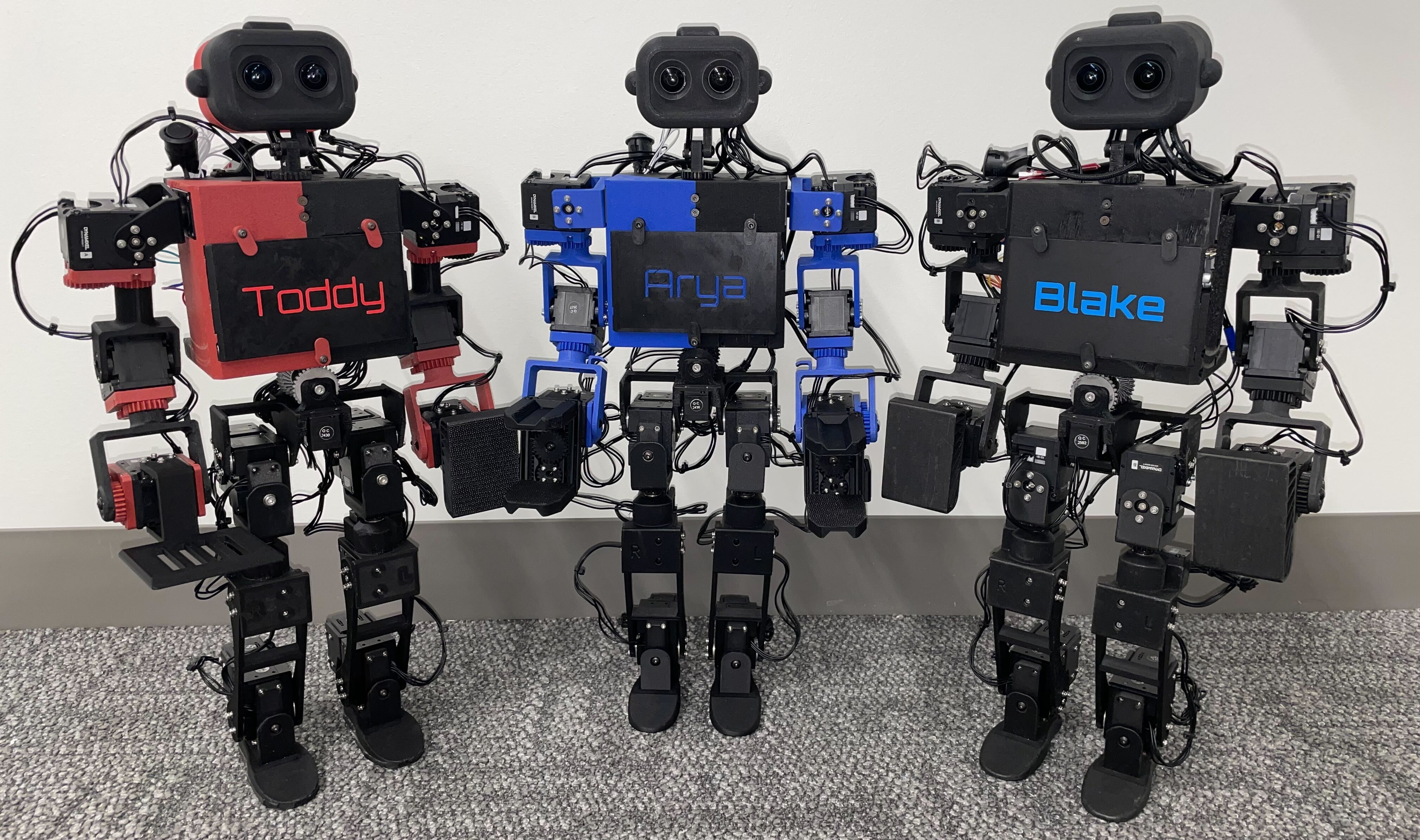
Media-only review: Upstream documentation photograph showing three ToddlerBot builds; their pictured accessories are not one complete configuration. Reuse basis: MIT; inspected LICENSE and the pinned file inventory for nearer notices. Original image unchanged; displayed responsively. This does not refresh technical or cost evidence.Revision, date & where cited
Haochen Shi and ToddlerBot contributors · github.com · revision
e337f3b· Image SHA-256 5f3bb71e087e50ff0008f6845bd35b3e82b96530956633fa953ebe16527061f6; repository · Accessed Oct 25, 2026
Videos
- S011 ToddlerBot: Open-Source ML-Compatible Humanoid Platform for Loco-Manipulation (YouTube video)
Video uploaded by Haochen Shi, linked from the project’s own documentation. Not reviewed by us for accuracy.Revision, date & where cited
YouTube video Haochen Shi · youtube.com · Accessed Oct 4, 2026
Correction guidance · Discussion is not enabled · Profile format 0.5.0-draft.1
Change history
2026-10-04 — Added 1 YouTube reference(s) (S011): official channel or videos linked from the pinned upstream sources. Existing claims, source-check dates and evidence are unchanged.
2026-10-25 — Added an attributed upstream image with linked reuse terms; technical evidence dates unchanged.