e-puck
Robot / hardware buildSmall wheeled research robot; this profile covers e-puck2 using its official hardware guide, pinned Qt monitor and separately preserved STM32F407 firmware sources. [1] [2] [5] [6]
Build & first use →Official website
- For
- Researchers distinguishing e-puck generations and firmware variants [1]
- Cost
- No current cost or bill of materials established yet.
- Source rights
- Some licenses are unresolved. Review licenses
- Unknowns
- host computer, tools not fully established. Review gaps
Source researched · Not tested by us
Sources checked · Research details
Licenses & related hardware
- License
- GPL-2.0-or-later · license not fully assessed for firmware, documentation · Details by part
Overview
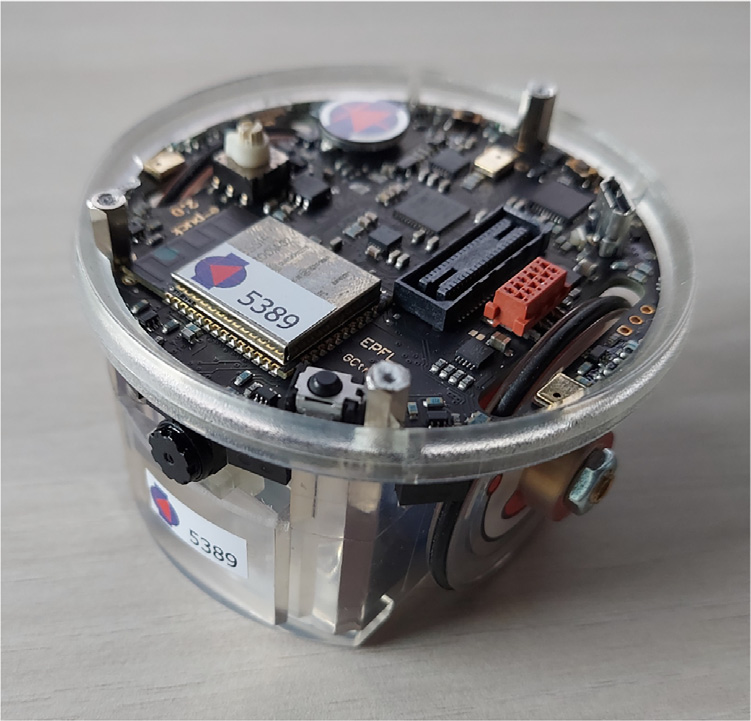
The e-puck2 is a small wheeled research robot with sensing and expansion interfaces. This profile selects e-puck2, while retaining the catalog's broader e-puck name. The original primary archive is the Qt desktop monitor, not a complete robot source package. The official guide and separately preserved STM32F407 firmware establish the additional context. [1] [5] [6]
Is this for you?
What you need
Hardware & parts
- Hardware configuration
Compact wheeled research platform; e-puck2 is the selected generation.
- Actuators
- Two geared stepper motors
- LEDs including radio-controlled RGB LEDs
- Speaker
- Controller
STM32F407 main controller, STM32F413 programmer/power-management controller and ESP32 radio module.
- Sensors
- Infrared proximity and ambient sensing
- Front time-of-flight distance sensor
- IMU
- Camera and digital microphones; component revisions vary
Assembly & first use
Cost
No current, complete configuration-specific build cost has been established for this profile.
3D preview
Preview not available yet. Design-source links are available, but the reviewed record does not establish unambiguous reuse rights for a hosted CAD preview.
Model sources
Design-source links are available, but the reviewed record does not establish unambiguous reuse rights for a hosted CAD preview.
Project notes
One robot has three different controller roles
The main STM32F407 handles sensors, actuators and robot algorithms. An STM32F413 provides programming/debugging and power-management functions. The ESP32 handles wireless communication and also controls the RGB LEDs and user button. Treating every behavior as main-controller firmware would miss those dependencies. [5]
The official documentation records changes within the e-puck2 family: the camera changed around July 2019, while hardware 2.2 changes the IMU and adds ESP32 PSRAM. It supplies separate radio factory images for hardware 2.0/2.1 and 2.2. These are configuration boundaries, not interchangeable specifications. No physical unit was inspected to identify its variant. [5]
The desktop-monitor route is narrower than embedded development
With the documented factory firmware, the guide uses selector position 8 and the main-controller USB serial port for the monitor. The debugger and radio serial ports are separate, and their operating-system numbering can vary. The monitor can display sensor information and camera images and control outputs, but using it is optional. [5]
The preserved monitor revision is b7fd0ae3095f56eda37027df8f54cfc0d16ec60d. Its build README names Qt 5.10.0 and historical deployment procedures. Those instructions do not establish compatibility with every current operating system. No application was installed, compiled or connected to a robot during this review. [1] [2]
Preserve firmware dependencies before claiming reproducibility
The separately archived main firmware is commit 3f174338a0bcc0e21cb75b5bd16dead0b2828a36. Its Git configuration lists ten submodules, including ChibiOS, Aseba and supporting communication libraries. Those payloads are not included merely by preserving the parent repository archive. The radio and programmer are also separate source and binary qualification tasks. [6] [7] [8]
The guide distinguishes classic Bluetooth factory operation from dedicated WiFi and BLE firmware routes, and provides a separate macOS 15 BLE option. It also warns that programmer updates differ for robot IDs at or above 5400. This profile records the distinctions without prescribing a flash operation for an unidentified robot. No firmware or bootloader was changed. [5]
What we checked
Source research only; no installation, physical build or performance test performed. No affiliate links added.
Not yet established
- Requirements: host computer, tools
- A step-by-step setup summary
Updates
- Upstream last updated
- Mar 9, 2021 [2]
- Latest release
- Not established
- Profile updated
- Oct 26, 2026
- Sources last checked
- Oct 1, 2026
- Next review
- Oct 31, 2026
- Reviewed revision
- b7fd0ae3095f56eda37027df8f54cfc0d16ec60d (commit snapshot; no published stable release found) · combined hardware and software repository
Source files and licenses
Available project sources support research coverage; complete build and commercial qualification remain separate.
| Layer | Availability / license |
|---|---|
| mechanical design | not found · License not fully assessed Official hardware descriptions available, but complete matched fabrication CAD/PCB sources and licenses not established in the selected software archives. This is not a claim that no hardware designs exist elsewhere. [4] [5] [8] |
| electronics | not found · License not fully assessed Official hardware descriptions available, but complete matched fabrication CAD/PCB sources and licenses not established in the selected software archives. This is not a claim that no hardware designs exist elsewhere. [4] [5] [8] |
| firmware | available · License not fully assessed Main STM32F407 firmware only. Complete licensing across source components and ten submodule dependencies is unresolved; radio/programmer sources were not preserved in this review. [6] [7] [8] [9] |
| software | available · GPL-2.0-or-later Monitor source notice allows GPL version 2 or later; included COPYING contains GPL3. This does not license the entire robot firmware or hardware. [1] [3] [10] |
| documentation | available · License not fully assessed Official guide preserved; an explicit blanket reuse license for wiki text/images was not established. [5] |
Selected conventional robot and monitor workflow does not require learned policy weights or training data.
License the source layer that was actually reviewed
The monitor's source notice allows GPL version 2 or later, while its included COPYING file contains GPL version 3. That software license does not establish the rights for all robot firmware or hardware. The selected main-firmware archive and its dependencies still need a complete component-license review. Complete matched fabrication CAD and PCB packages were not established from these software sources. [3] [4] [7] [8] [10]
The remaining build questions are concrete: identify the actual robot revision, match all three firmware roles and host tools, and establish delivered costs and applicable source rights. The catalog has not tested motion, camera performance, wireless behavior or sensor accuracy. [5]
References
Each source links to the exact revision we read. “Used for” shows where this page relies on it.
- S001 e-puck2/monitor: README.md
Revision, date & where cited
github.com · revision
b7fd0ae· Accessed Oct 1, 2026
Used for: Overview, Is this for you?, What you need, Assembly & first use and 2 more - S002 e-puck2/monitor: commit b7fd0ae
Revision, date & where cited
github.com · Accessed Oct 1, 2026
Used for: The desktop-monitor route is narrower than embedded development, What we checked - S003 e-puck2/monitor: COPYING
Revision, date & where cited
github.com · revision
b7fd0ae· Accessed Oct 1, 2026
Used for: Source files and licenses - S004 e-puck2/monitor: files
Revision, date & where cited
github.com · revision
b7fd0ae· archive file inventory · Accessed Oct 1, 2026
Used for: Source files and licenses - S005 Official e-puck2 hardware and software guide
Revision, date & where cited
e-puck2 / project contributors · gctronic.com · Wiki revision 2954; retrieved October 1 2026 · Accessed Oct 1, 2026
Used for: Overview, Is this for you?, What you need, Hardware & parts and 4 more - S006 e-puck2 main firmware README.md
Revision, date & where cited
github.com · revision
3f17433· Accessed Oct 1, 2026
Used for: Overview, Hardware & parts, Preserve firmware dependencies before claiming reproducibility, Source files and licenses - S007 e-puck2 main firmware .gitmodules
Revision, date & where cited
github.com · revision
3f17433· Accessed Oct 1, 2026
Used for: Is this for you?, What you need, Preserve firmware dependencies before claiming reproducibility, Source files and licenses - S008 e-puck2 main firmware inventory.json
Revision, date & where cited
github.com · revision
3f17433· Accessed Oct 1, 2026
Used for: Preserve firmware dependencies before claiming reproducibility, Source files and licenses - S009 e-puck2 main firmware src/main.c
Revision, date & where cited
github.com · revision
3f17433· Accessed Oct 1, 2026
Used for: Source files and licenses - S010 Monitor source license notice
Revision, date & where cited
github.com · revision
b7fd0ae· EpuckMonitor.cpp header · Accessed Oct 1, 2026
Used for: Source files and licenses - S011 Upstream image and reuse attribution
Media-only review: Upstream paper photograph of an e-puck2 robot (Figure 1, 2023). Reuse basis: CC-BY-4.0. Inspected the source image, its caption and the actual reuse declaration; no image-specific exception or different credit was found for this selected image. The grant is used only for this media, not as a new hardware/software license. Embedded image extracted from page 2 of the source PDF and losslessly decoded to PNG; no retouching. Technical/cost evidence dates unchanged.Revision, date & where cited
Daniel H. Stolfi and Grégoire Danoy · doi.org · Figure 1, PDF page 2; image SHA-256 76e3f5198cc856dad416094234bc79f804a1f12edd717779050de2e3885a2417 · Accessed Oct 26, 2026
Correction guidance · Discussion is not enabled · Profile format 0.6.0-draft.1
Change history
2026-10-26 — Added attributed upstream media with linked reuse terms; technical evidence dates unchanged.