JetBot
Robot / hardware buildSmall Jetson Nano educational robot with printed chassis and browser-based control; the reviewed 0.4.3 build uses legacy Nano-specific images and matched wheel/caster parts. [1]
Build & first use →Official websiteBill of materials
- For
- Learners comfortable with soldering, printed parts and a version-specific Jetson setup [1]
- Cost
- No current cost yet. Upstream bill of materials [5]
- Source rights
- Some licenses are unresolved. Review licenses
- Unknowns
- tools, operating system not fully established. Review gaps
Source researched · Not tested by us
Sources checked · Research details

Licenses & related hardware
- License
- MIT · license not fully assessed for mechanical design, electronics · Details by part
Overview
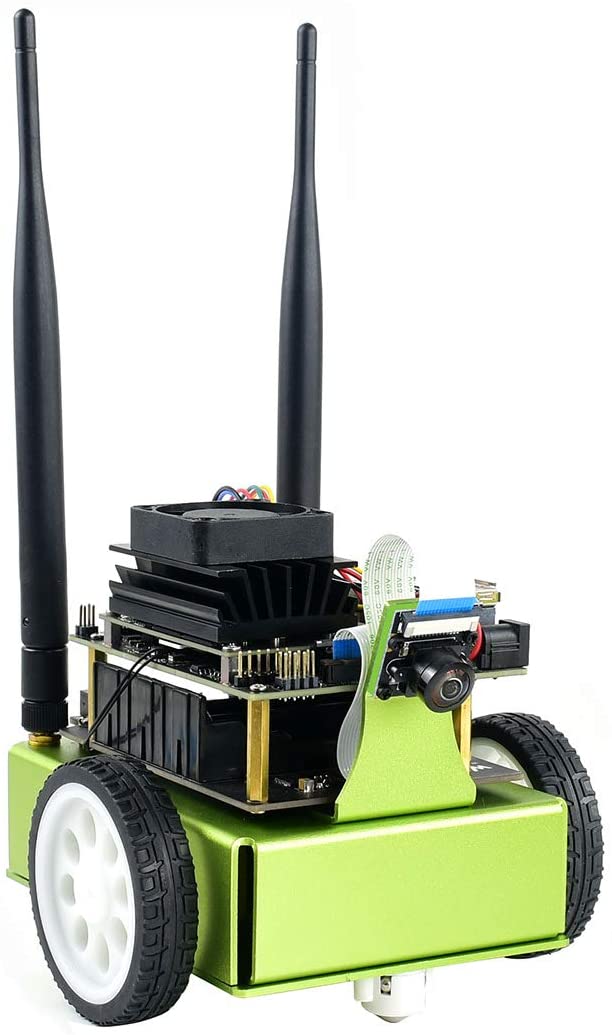
JetBot is a small educational robot built around NVIDIA Jetson Nano, with two driven wheels, a ball caster and a printed chassis. This profile follows the original Nano 4 GB build and basic browser-controlled motion route in the preserved 0.4.3 source. Its documented configuration should not be assumed to cover newer Jetson hardware or every third-party JetBot kit. [1] [2] [5] [7]
Is this for you?
3D preview
JetBot 65 mm chassis model. The chassis and supplied caster geometry from the repository’s 65 mm design. This is not a complete powered robot with drive wheels, electronics and camera.
The 3D preview loads after the page.
Drag to orbit · Scroll or pinch to zoom · Right-drag to pan. Use the view buttons for front, side and top views. The tree shows names supplied by the source; unnamed bodies remain labeled as such.
Download original STEP · File checksums and provenance
Separate bodies can be inspected in the model tree. Explode is a viewing aid, not an assembly sequence.
Model sources
The preview uses the linked original design. Source grouping is retained where present; the caption identifies whether this is an assembly or one component.
Source, license and scale
Source: NVIDIA Corporation; STEP author chitoku, revision 5afa9ca18143e7f1a9579e60113a848e3f2d8ce6. Original and preview: MIT. Preview conversion by Open Source Robotics; original file unchanged. Preview coordinates are centered and rounded to six decimal places. STEP preview triangulated in millimetres. No physical part tested.
Viewer: three-cad-viewer 5.0.7 (MIT license). Confirm scale and manufacturing settings before printing.
What you need
Hardware & parts
Upstream bill of materials [5]
- Actuators
- Two TT-form-factor geared motors with an Adafruit motor driver
- Controller
Original Jetson Nano; this profile selects the 4 GB route with its matching 0.4.3 image.
Editorial configuration selection from the documented options.
- Sensors
- Select a documented IMX219 camera configuration and field of view
Assembly & first use
Cost
No current, complete configuration-specific build cost has been established for this profile.
Project notes
Choose the parts as one configuration
The bill of materials offers camera, Wi-Fi and wheel alternatives. Its default M.2 Wi-Fi route is intended for the original Nano 4 GB; the Nano 2 GB has no M.2 connector and needs a suitable alternative, such as a documented USB adapter. The camera choices also specify sensor and field of view, rather than treating every camera as interchangeable. [5]
Wheel diameter affects the printed caster assembly. The 60 mm and 65 mm options have different caster bases and shrouds. The repository preserves the printable STL files under assets; its docs/cad link resolves to that directory. Upstream specifies millimetres for the STL units and recommends PLA. These files were inspected as preserved artifacts, but were not printed or checked for fit here. [4] [5] [8]
Assembly includes soldering the motor-driver terminals and display headers. The hardware guide also carries a correction to a motor-wiring photograph: the pictured motor lead polarities are reversed and would make the motors turn backwards. Follow the correction and verify direction during the basic-motion setup, with power removed before changing wires as the notebook instructs. [6] [11]
The overview's less-than-$150 figure is explicitly an add-on to Jetson Nano, not a complete robot price. The historical bill of materials includes the Nano, purchased electronics, fasteners and alternatives, while printed components require a separate production choice. Current availability, shipping and a complete configuration-specific delivered cost were not verified. [1] [5] [8]
Use the image for the selected Nano
The 0.4.3 setup table provides separate Nano 2 GB and Nano 4 GB images, both paired with JetPack 4.5. Upstream recommends initially booting without the display and motor driver attached, then reconnecting after checking the image boots. The image route disables the desktop GUI to reduce memory use and uses local-network Jupyter access for programming. This review did not download, flash or boot either image. [7]
Preserving the Git repository does not preserve those externally hosted system images. It also does not verify compatibility with a later JetPack release. Keep the selected board, image and software revision together when reproducing this build. [2] [7]
Motor command values are not measured speed
The motion notebook introduces left, right, forward, backward and stop commands. The source sends scaled values to the motor driver, with configurable per-motor scaling and bounded driver output. These are drive commands, not calibrated metres-per-second targets or evidence of closed-loop wheel-speed control. [9] [10] [11]
For timed motion, the notebook explicitly commands movement, waits and calls stop. Although the source's forward method accepts a duration argument, its body does not use that argument to stop the robot. Do not treat that parameter as an implemented timed-stop feature in this revision. The notebook separately demonstrates a browser heartbeat callback that calls stop when the heartbeat becomes dead; that example has to be configured and executed and was not tested here. [9] [11]
The source root carries MIT terms for software and associated documentation. Printable parts are available, but this review did not establish a separate hardware-design license, complete purchased-board sources or the terms of every external system component. The selected basic-motion route includes no downloaded learned policy or training dataset, and no assembly, driving or vision performance result is claimed. [3] [4] [7]
What we checked
Source research only; no installation, physical build or performance test performed. No affiliate links added.
Not yet established
- Requirements: operating system, tools
- A step-by-step setup summary
Updates
Source files and licenses
Available project sources support research coverage; complete build and commercial qualification remain separate.
| Layer | Availability / license |
|---|---|
| mechanical design | available · License not fully assessed Printable STL files preserved; docs/cad points to ../assets. No separate hardware-design license or native parametric design established. [4] [5] [8] |
| electronics | available · License not fully assessed Wiring and integration guide, not complete manufacturer source for purchased electronics. [6] |
| firmware | not found · License not fully assessed Board-specific system image paths documented; complete firmware source and image payload not preserved by this profile. [7] |
| software | available · MIT Root software license; external JetPack, images and dependencies have separate terms. [3] |
| documentation | available · MIT Root license names associated documentation; external linked content not covered by this finding. [3] [4] |
Selected physical build and basic motion route uses no learned policy; vision tutorials are separate experiments.
References
Each source links to the exact revision we read. “Used for” shows where this page relies on it.
- S001 NVIDIA-AI-IOT/jetbot: README.md
Revision, date & where cited
github.com · revision
5afa9ca· Accessed Oct 1, 2026
Used for: Overview, Assembly & first use, Choose the parts as one configuration - S002 NVIDIA-AI-IOT/jetbot: commit 5afa9ca
Revision, date & where cited
github.com · Accessed Oct 1, 2026
Used for: Overview, Use the image for the selected Nano, What we checked - S003 NVIDIA-AI-IOT/jetbot: LICENSE.md
Revision, date & where cited
github.com · revision
5afa9ca· Accessed Oct 1, 2026
Used for: Motor command values are not measured speed, Source files and licenses - S004 NVIDIA-AI-IOT/jetbot: files
Revision, date & where cited
github.com · revision
5afa9ca· archive file inventory · Accessed Oct 1, 2026
Used for: Choose the parts as one configuration, Motor command values are not measured speed, Source files and licenses - S005 JetBot 0.4.3: docs/bill_of_materials.md
Revision, date & where cited
github.com · revision
5afa9ca· Accessed Oct 1, 2026
Used for: Overview, Is this for you?, Hardware & parts, Assembly & first use and 2 more - S006 JetBot 0.4.3: docs/hardware_setup.md
Revision, date & where cited
github.com · revision
5afa9ca· Accessed Oct 1, 2026
Used for: Hardware & parts, Assembly & first use, Choose the parts as one configuration, Source files and licenses - S007 JetBot 0.4.3: docs/software_setup/sd_card.md
Revision, date & where cited
github.com · revision
5afa9ca· Accessed Oct 1, 2026
Used for: Overview, Is this for you?, What you need, Hardware & parts and 3 more - S008 JetBot 0.4.3: docs/3d_printing.md
Revision, date & where cited
github.com · revision
5afa9ca· Accessed Oct 1, 2026
Used for: Assembly & first use, Choose the parts as one configuration, Source files and licenses - S009 JetBot 0.4.3: jetbot/robot.py
Revision, date & where cited
github.com · revision
5afa9ca· Accessed Oct 1, 2026
Used for: Is this for you?, What you need, Motor command values are not measured speed - S010 JetBot 0.4.3: jetbot/motor.py
Revision, date & where cited
github.com · revision
5afa9ca· Accessed Oct 1, 2026
Used for: Is this for you?, Motor command values are not measured speed - S011 Basic motion notebook
Revision, date & where cited
github.com · revision
5afa9ca· notebook text and code · Accessed Oct 1, 2026
Used for: What you need, Assembly & first use, Choose the parts as one configuration, Motor command values are not measured speed - S012 Upstream image and reuse attribution
Media-only review: Upstream photograph of a JetBot hardware configuration; camera, compute and chassis variants can differ. Reuse basis: MIT; inspected LICENSE.md and the pinned file inventory for nearer notices. Original image unchanged; displayed responsively. This does not refresh technical or cost evidence.Revision, date & where cited
NVIDIA and JetBot contributors · github.com · revision
5afa9ca· Image SHA-256 5ac34bc7b8d4cae3d196091687a5b776a78f24231ed3ede4cc8ad5858cf67b8c; repository · Accessed Oct 25, 2026
Correction guidance · Discussion is not enabled · Profile format 0.6.0-draft.1
Change history
2026-10-25 — Added an attributed upstream image with linked reuse terms; technical evidence dates unchanged.