Magni
Robot / hardware buildMobile robot base with available ROS host software; the reviewed setup follows separately preserved Noetic sources, with unreleased controller firmware and revision-specific hardware constraints. [5] [12]
Build & first use →Official website
- For
- ROS developers extending a Magni base with a known controller and sensor configuration [1]
- Cost
- No current cost or bill of materials established yet.
- Source rights
- Some licenses are unresolved. Review licenses
- Unknowns
- tools, operating system not fully established. Review gaps
Source researched · Not tested by us
Sources checked · Research details
Licenses & related hardware
- License
- BSD-3-Clause · license not fully assessed for mechanical design, documentation · Details by part
Overview
Magni is a mobile robot base with a top mounting plate for application-specific equipment. Available host software configures its ROS nodes and communicates with the motor controller. This profile covers the documented Noetic route using separately preserved robot and motor-interface source snapshots; it does not present the entire platform as open hardware. [5] [8] [13]
Is this for you?
3D preview
Magni simulation model. Source robot-description visuals, including the chassis and wheels, at zero joint positions. This simulation model does not establish a manufacturing package or every sensor configuration.
The 3D preview loads after the page.
Drag to orbit · Scroll or pinch to zoom · Right-drag to pan. Use the view buttons for front, side and top views. The tree shows names supplied by the source; unnamed bodies remain labeled as such.
Download original URDF source bundle (ZIP) · File checksums and provenance
Separate bodies can be inspected in the model tree. Explode is a viewing aid, not an assembly sequence.
Model sources
The preview uses the linked original design. Source grouping is retained where present; the caption identifies whether this is an assembly or one component.
Source, license and scale
Source: Ubiquity Robotics, revision 275a3becb8ce7009e408518fa7ebcfd0306b6805. Original and preview: BSD-3-Clause. Preview conversion by Open Source Robotics; source files unchanged inside the downloadable bundle. Preview coordinates are centered and rounded to six decimal places. URDF visual origins, mesh scales and joint transforms applied at zero joint positions, then metres converted to millimetres. No physical part tested.
Viewer: three-cad-viewer 5.0.7 (MIT license). Confirm scale and manufacturing settings before printing.
What you need
Hardware & parts
Assembly & first use
- Assembly
Purchased base with mounting drawings and board-revision documentation; complete fabrication sources and BOM not established.
Artifact-scope finding, not a build test.
- Calibration
Review effective robot.yaml settings and camera/lidar extrinsics; user overrides take priority over package defaults.
Editorial setup check derived from documented configuration precedence.
[6] · Editorial assessment
Cost
No current, complete configuration-specific build cost has been established for this profile.
Project notes
The default repository snapshot is a different software route
The primary collected repository snapshot contains ROS 2 description and simulation launch files, and its README explicitly says other portions still need porting from ROS 1. The separately preserved Noetic branch includes the bring-up, teleoperation and navigation configuration discussed here. That branch selection is deliberate: the manufacturer's Noetic image instructions start ROS core and Magni services and cannot be treated as instructions for the incomplete ROS 2 snapshot. [1] [5] [6] [11]
The image guide calls for a Raspberry Pi and an SD card of at least 16 GB. Images include ROS and Magni packages, while Conveyorbot and EZ-Map images are supplied separately. The source archives inspected here do not include a validated copy of those images or establish the terms of every installed application. No image was flashed or booted for this review. [11]
Configuration overrides can change the running robot
The Noetic bring-up documentation explains that the magni-base service launches base nodes and generates a configuration-dependent launch file. Motor settings come first from /etc/ubiquity/robot.yaml; missing values fall back individually to package defaults. A partially populated override can therefore produce a mixture of local and default settings. Inspect the effective configuration when moving an SD card or software checkout between robots. [6]
Camera and lidar extrinsics also have override locations. The chosen sensor and position in the robot configuration determine which calibration file is used, with user files taking priority over packaged files. A sensor mount change should trigger a review of the selected extrinsics rather than an assumption that the package defaults still describe the robot. These are editorial setup recommendations based on the documented precedence rules. [6]
The motor interface subscribes to velocity commands and publishes odometry, firmware identification and motor state. Those outputs are useful for checking what is running, but a ROS topic name alone does not establish correct wheel calibration, sensor placement or an independently tested stop function. This publication performed no driving or controller validation. [8]
Hardware revisions constrain replacement parts
The manufacturer's revision history records changes to the main controller board and its paired switch board. In particular, it says MCB revision 5.0 requires the newer revision 2.0 switch board with four resistors and will not power up with the older three-resistor board. It also records firmware changes that required corresponding host-side updates. These historical tables are evidence that revisions matter, not a recommendation to install whichever firmware number appears last in an old guide. [12]
The setup requirements include two 12 V lead-acid batteries because the robot ships without them, plus a CR2032 clock battery. A purchased-base price would therefore not automatically be a complete operational budget. Current delivered cost, battery sourcing and a full build-specific bill of materials remain unverified. [10]
Record the complete configuration
For a configuration record, preserve the following together. This checklist is an editorial synthesis of the source and setup requirements:
- The reviewed
magni_robotNoetic commitdfaee639044f81ce5ec46473408a02b6dc452114andubiquity_motorcommit52a35ba5b2f46113e48c0524a6d9b72a446c28e2. [5] [8] - The installed image identifier and ROS environment, plus the physical MCB and switch-board revisions. [11] [12]
- The firmware version and date code reported by the controller interface. [8] [12]
/etc/ubiquity/robot.yaml, the package defaults it falls back to, and the selected camera/lidar extrinsic files. [6]
Only the named source snapshots and documentation were preserved by this review. The installed image, board and firmware combination remains unverified.
What we checked
Source research only; no installation, physical build or performance test performed. No affiliate links added.
Not yet established
- Requirements: operating system, tools
- A step-by-step setup summary
Updates
- Upstream last updated
- Jan 7, 2026 [2]
- Latest release
- Not established
- Profile updated
- Oct 26, 2026
- Sources last checked
- Oct 1, 2026
- Next review
- Oct 31, 2026
- Reviewed revision
- 275a3becb8ce7009e408518fa7ebcfd0306b6805 (commit snapshot; no published stable release found) · combined hardware and software repository
Source files and licenses
Available project sources support research coverage; complete build and commercial qualification remain separate.
| Layer | Availability / license |
|---|---|
| mechanical design | available · License not fully assessed Mounting dimensions and board-outline references; no complete editable fabrication design established. [13] |
| electronics | not found · License not fully assessed Revision history and board information inspected, but complete matching electronics CAD and BOM not preserved. [12] [13] |
| firmware | not found · License not fully assessed Selected Noetic README explicitly states motor-controller firmware is not to be released. Firmware revision documentation does not supply its source. [5] [12] |
| software | available · BSD-3-Clause Selected Noetic packages and separate motor interface have BSD-3-Clause text; no blanket license for image, firmware or application suites. [5] [7] [8] [9] |
| documentation | available · License not fully assessed Website footer identifies BSD-3-Clause; full coverage of external linked artifacts not assessed. [10] [11] [12] [13] |
Base-platform and ROS setup profile without a selected learned policy or dataset.
Host source availability does not include controller firmware
The selected Noetic README explicitly says the motor-controller firmware is not to be released. Its public host packages and the separately inspected motor-interface repository carry BSD-3-Clause license text, but that does not establish firmware source availability or a fully reproducible controller build. The profile records this as partial source availability. [5] [7] [9]
Mechanical dimensions and board information are available in the manufacturer's documentation, but this review did not establish a complete editable fabrication package or matching electronics design. No assembly, image installation, calibration, payload test or navigation result is claimed. [12] [13]
References
Each source links to the exact revision we read. “Used for” shows where this page relies on it.
- S001 UbiquityRobotics/magni_robot: README.md
Revision, date & where cited
github.com · revision
275a3be· Accessed Oct 1, 2026
Used for: Is this for you?, Assembly & first use, The default repository snapshot is a different software route - S002 UbiquityRobotics/magni_robot: commit 275a3be
- S004 UbiquityRobotics/magni_robot: files
Revision, date & where cited
github.com · revision
275a3be· archive file inventory · Accessed Oct 1, 2026 - S005 Separate Magni noetic source: README.md
Revision, date & where cited
github.com · revision
dfaee63· Accessed Oct 1, 2026
Used for: Overview, Is this for you?, What you need, The default repository snapshot is a different software route and 2 more - S006 Separate Magni noetic source: magni_bringup/README.md
Revision, date & where cited
github.com · revision
dfaee63· Accessed Oct 1, 2026
Used for: What you need, Assembly & first use, The default repository snapshot is a different software route, Configuration overrides can change the running robot and 1 more - S007 Separate Magni noetic source: magni_bringup/LICENSE
Revision, date & where cited
github.com · revision
dfaee63· Accessed Oct 1, 2026
Used for: Source files and licenses - S008 Separate Magni motor source: README.md
Revision, date & where cited
github.com · revision
52a35ba· Accessed Oct 1, 2026
Used for: Overview, What you need, Hardware & parts, Configuration overrides can change the running robot and 2 more - S009 Separate Magni motor source: LICENSE
Revision, date & where cited
github.com · revision
52a35ba· Accessed Oct 1, 2026
Used for: Source files and licenses - S010 Manufacturer documentation: noetic-start
Revision, date & where cited
UbiquityRobotics / project contributors · learn.ubiquityrobotics.com · Preserved website text; historical revision tables and Noetic route · Accessed Oct 1, 2026
Used for: What you need, Hardware & parts, Assembly & first use, Hardware revisions constrain replacement parts and 1 more - S011 Manufacturer documentation: noetic-images
Revision, date & where cited
UbiquityRobotics / project contributors · learn.ubiquityrobotics.com · Preserved website text; historical revision tables and Noetic route · Accessed Oct 1, 2026
Used for: What you need, Hardware & parts, The default repository snapshot is a different software route, Record the complete configuration and 1 more - S012 Manufacturer documentation: mcb-revisions
Revision, date & where cited
UbiquityRobotics / project contributors · learn.ubiquityrobotics.com · Preserved website text; historical revision tables and Noetic route · Accessed Oct 1, 2026
Used for: Is this for you?, What you need, Assembly & first use, Hardware revisions constrain replacement parts and 2 more - S013 Manufacturer documentation: mechanical
Revision, date & where cited
UbiquityRobotics / project contributors · learn.ubiquityrobotics.com · Preserved website text; historical revision tables and Noetic route · Accessed Oct 1, 2026
Used for: Overview, Hardware & parts, Assembly & first use, Source files and licenses - S014 Upstream image and reuse attribution
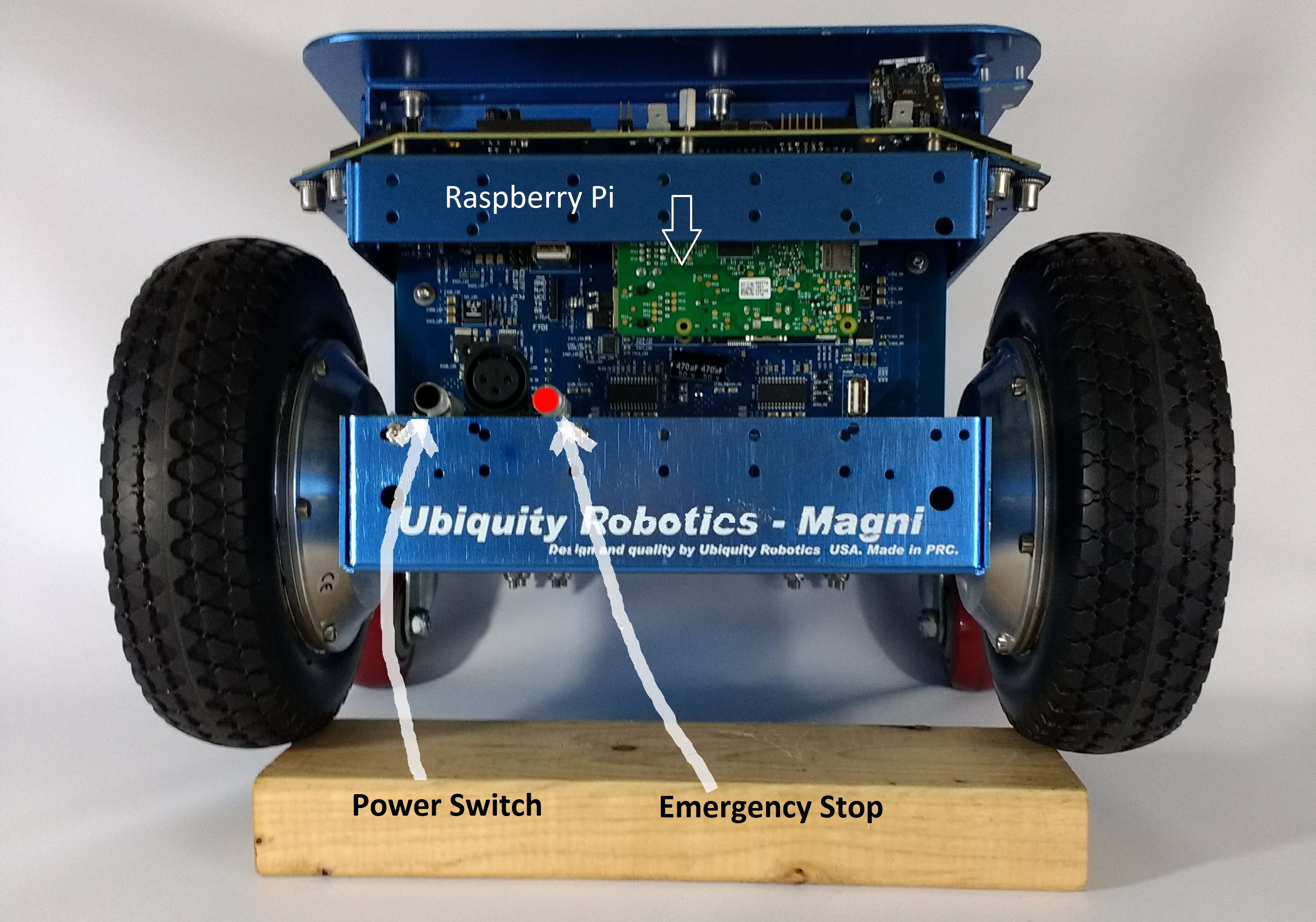
Media-only review: Upstream documentation photograph of Magni with labeled Raspberry Pi and power controls; this historical view is not a match for every later controller revision. Reuse basis: BSD-3-Clause. Inspected the source image, its caption and the actual reuse declaration; no image-specific exception or different credit was found for this selected image. The grant is used only for this media, not as a new hardware/software license. Original image unchanged; displayed responsively. Technical/cost evidence dates unchanged.Revision, date & where cited
Ubiquity Robotics · learn.ubiquityrobotics.com · Official documentation revision f3352d23, front-view photograph and page license footer; image SHA-256 98fe36d3cc623c476c18d1e7e52863496ad153f58c3387f00cb8209b43d8417f · Accessed Oct 26, 2026
Correction guidance · Discussion is not enabled · Profile format 0.6.0-draft.1
Change history
2026-10-26 — Added attributed upstream media with linked reuse terms; technical evidence dates unchanged.